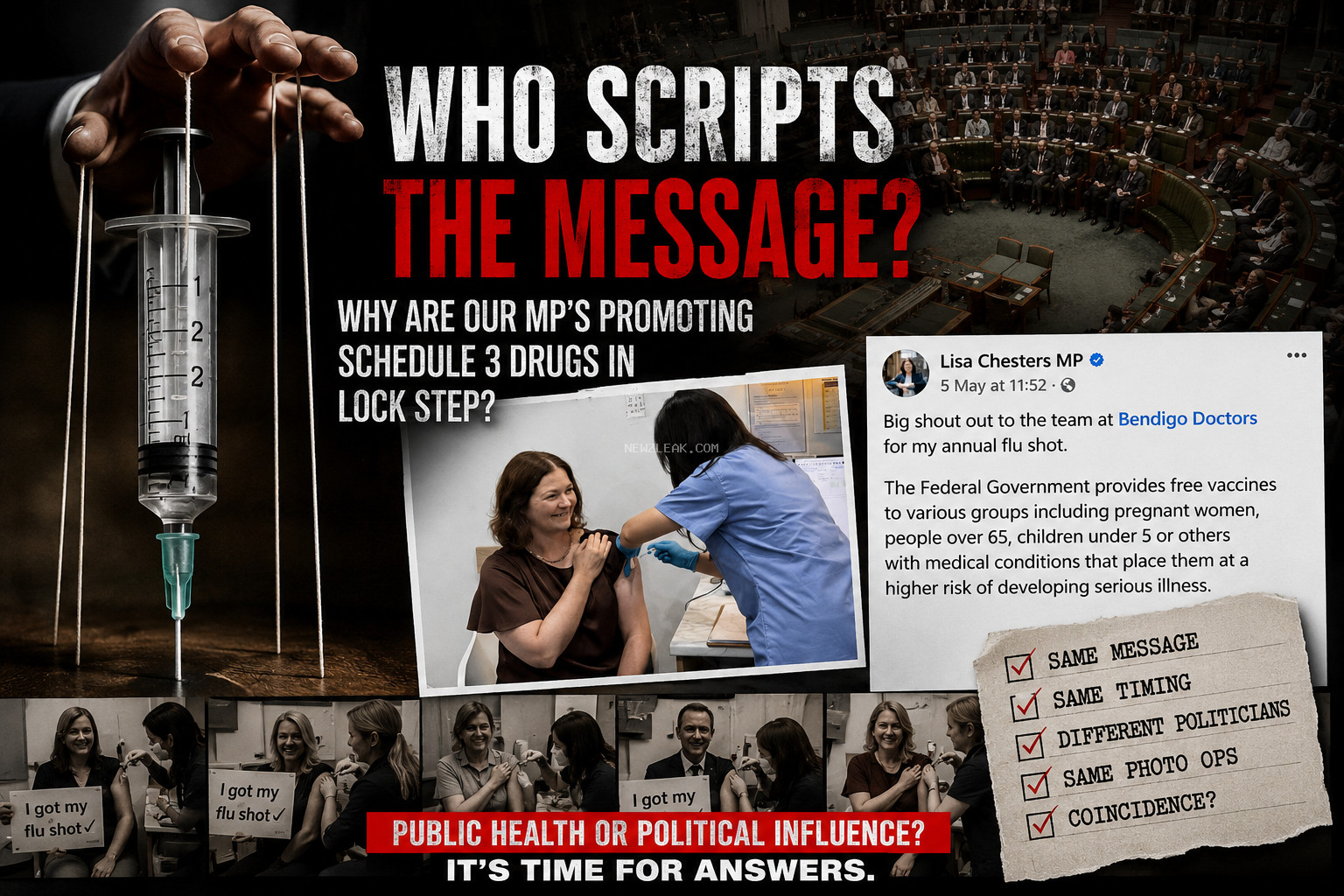
A curious trend has emerged across Australian politics in recent weeks — and it’s becoming difficult to ignore.
Across party lines, Members of Parliament are posting near-identical images of themselves receiving flu vaccinations. Some smile for the camera. Some pose mid-injection. Others go a step further, holding signs or adding messaging that encourages the public to follow suit.
On its own, one or two politicians sharing a personal health decision wouldn’t raise eyebrows. But this isn’t that.
This is coordinated in timing, consistent in messaging, and widespread across the political spectrum.
So the obvious question is: why?
Why are elected officials — whose role is governance, not health promotion — suddenly engaging in what looks remarkably like a synchronised campaign?
And more importantly: who benefits?
Australia has strict rules around the promotion of certain pharmaceuticals. These safeguards exist for a reason — to ensure medical decisions remain between individuals and qualified health professionals, free from marketing pressure.
Yet here we are, watching a wave of public figures using their platform and influence to promote a specific medical behaviour, in a highly visible and repetitive way.
Is this simply a well-intentioned public health message?
Or does it blur the line between guidance and persuasion?
There is a difference.
Public health campaigns are typically led by health authorities, backed by data, and delivered through structured, accountable channels. What we are seeing instead feels different — informal, personality-driven, and amplified through social media in a way that carries far more emotional weight than a government advisory ever could.
That raises uncomfortable questions.
Were MPs encouraged to do this?
Was there internal coordination?
Or is this a case of political culture — where one visible act quickly becomes an unspoken expectation?
When dozens of politicians independently arrive at the same messaging, at the same time, expressed in the same way, coincidence becomes harder to accept.
Even if the intent is benign, the optics matter.
Elected officials hold significant influence over public opinion. When that influence is used to promote personal medical decisions — even indirectly — it risks shaping behaviour in ways that may not be appropriate outside a clinical setting.
At minimum, the public deserves clarity.
Who initiated this wave of messaging?
Was it discussed within party structures, advisory groups, or government departments?
And what safeguards are in place to ensure that public trust isn’t being leveraged — intentionally or otherwise — to influence personal health choices?
These are not fringe concerns. They go to the heart of transparency, accountability, and the proper role of elected representatives.
Because if politicians begin acting as de facto advocates for specific medical actions, even under the banner of public good, we need to ask where the line is — and who decides when it’s crossed.
Hard questions aren’t just appropriate here.
They’re necessary.