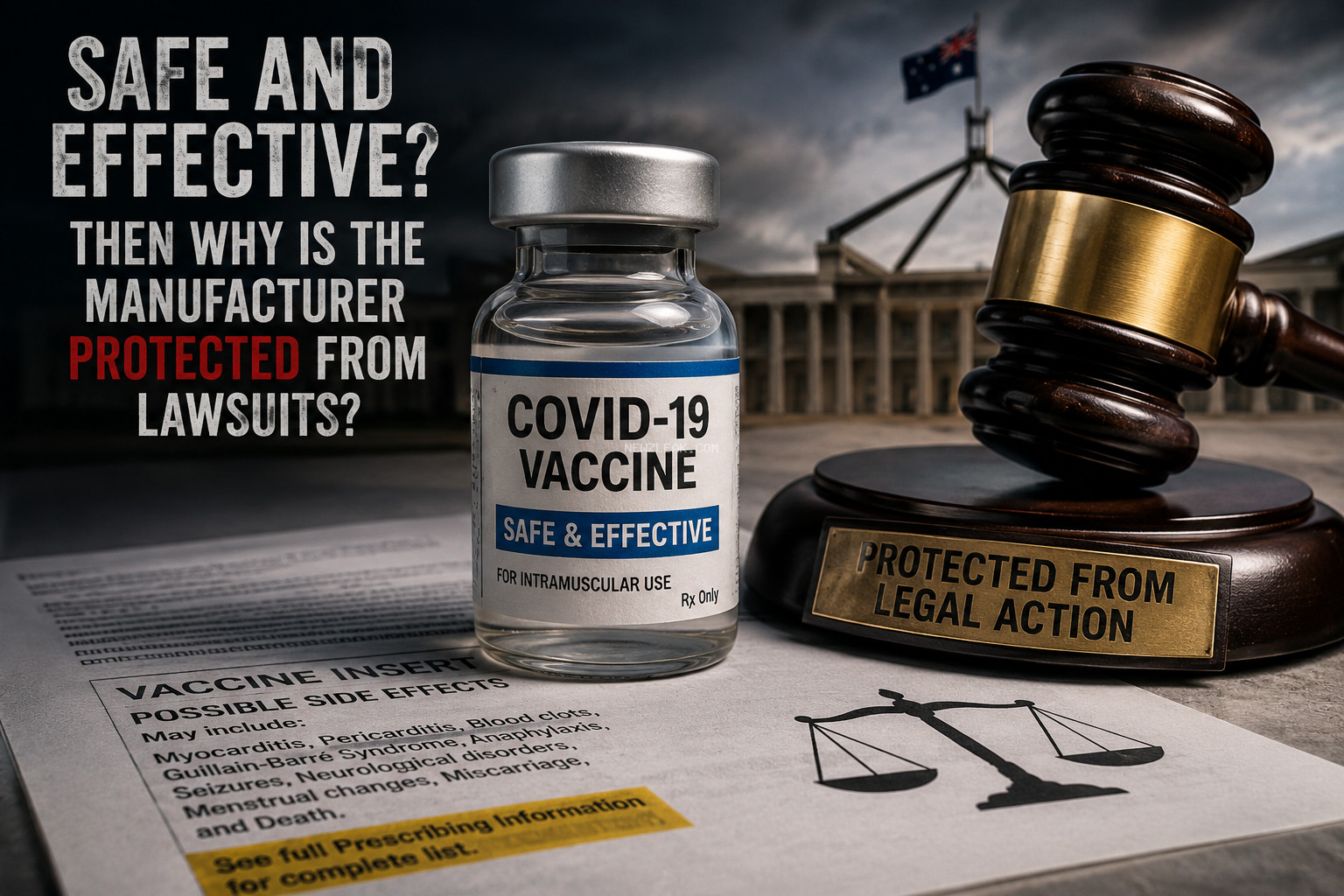
One of the cornerstones of consumer protection in modern society is simple: if a company releases a faulty product that harms people, the public has the right to seek legal action.
That principle is what keeps manufacturers honest.
Car companies recall defective vehicles because they fear lawsuits. Pharmaceutical companies spend billions testing medications because they fear liability. Food manufacturers obsess over contamination standards because they fear being held accountable.
The possibility of legal action is not a flaw in the system — it is the system.
Which raises an uncomfortable but entirely reasonable question:
Why were vaccine manufacturers granted extraordinary legal protections against adverse event lawsuits?
Governments around the world repeatedly assured the public that COVID vaccines were “safe and effective.” That phrase became a slogan repeated endlessly across television screens, government advertisements and social media campaigns.
Yet at the same time, many vaccine manufacturers received legal indemnity or liability protections that largely shielded them from direct legal consequences if people suffered serious side effects.
To many ordinary Australians, that contradiction still doesn’t sit right.
If a product is unquestionably safe, why remove one of the most fundamental consumer protections ever established?
If the science was so settled, why was the legal risk considered significant enough to require protection from lawsuits?
These are not “anti-vaccine” questions.
They are accountability questions.
Every medical product carries risk. Even government agencies acknowledge this openly in vaccine inserts and medical literature. Rare side effects, complications and adverse reactions have always existed with pharmaceutical products. That reality alone is not controversial.
What many people object to is the messaging disconnect.
The public was presented with absolute certainty:
“Safe and effective.”
But buried deep within lengthy product disclosures and fine-print documentation were acknowledgements that adverse reactions could and did occur.
At the same time, citizens were often socially pressured, professionally pressured or in some cases financially pressured into compliance.
Workers lost jobs.
People were excluded from venues.
Families were divided.
Questions were dismissed.
Meanwhile, the corporations behind the products were insulated from the very legal accountability mechanisms that govern virtually every other industry.
That double standard deserves scrutiny.
Supporters of the protections argue they were necessary during a global emergency. Governments wanted rapid vaccine development and mass production. Pharmaceutical companies, they say, would never have moved fast enough if they faced decades of potential litigation hanging over them.
There is logic to that argument.
But emergency powers and emergency protections should never be beyond public examination — especially years later, now that emotions have cooled and more data has emerged.
The issue is no longer simply about vaccines themselves.
It is about precedent.
What happens when governments partner with giant corporations, heavily promote a product, pressure uptake, minimise public debate and then simultaneously remove traditional legal accountability?
That question should concern everyone, regardless of political position or vaccination status.
A healthy society should be able to ask difficult questions without immediately branding people as extremists, conspiracy theorists or “anti-science.”
Real science welcomes scrutiny.
Real democracy welcomes debate.
And real consumer protection should never disappear simply because the product in question is politically sensitive.
If legal liability is considered too dangerous for manufacturers to bear, perhaps the public has a right to fully understand why.