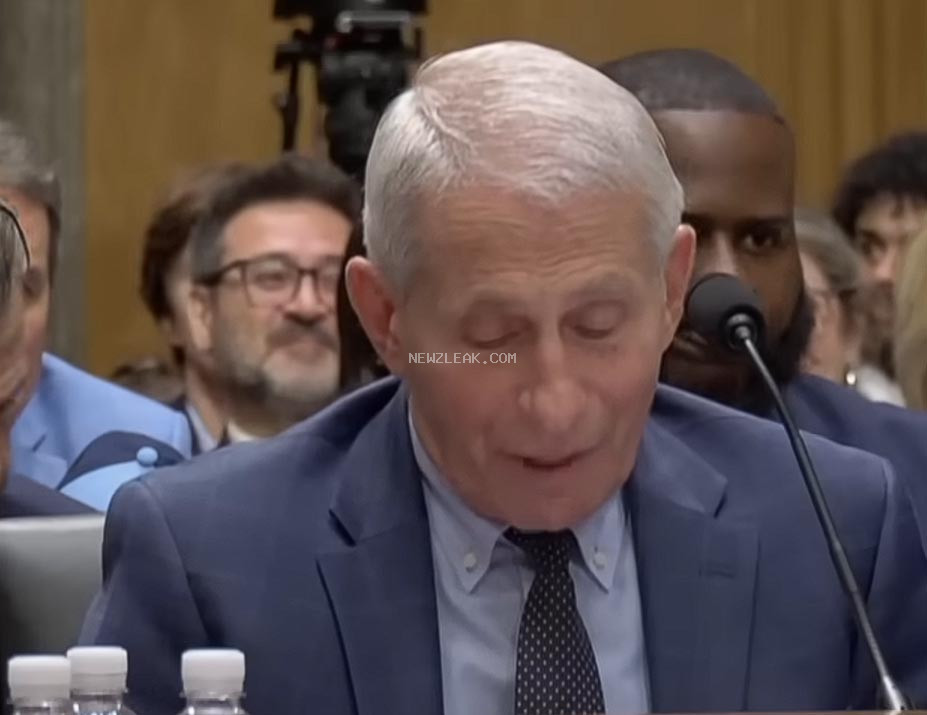
For years, Dr. Anthony Fauci was one of the most recognisable public officials in the world. Throughout the COVID-19 pandemic, he became the face of America's public health response, appearing regularly on television and assuring the public that the nation's response was being guided by science.
This week, he found himself in a very different setting.
Appearing before the U.S. Senate Homeland Security and Governmental Affairs Committee in Washington, D.C., Fauci was called to answer questions following the release of his personal pandemic-era diary and a series of allegations concerning his time as Director of the National Institute of Allergy and Infectious Diseases (NIAID).
Rather than answering the committee's questions, Fauci invoked the Fifth Amendment 111 times.
Among the issues senators sought to explore were allegations surrounding the administration of cash award programs during Fauci's tenure, with claims that more than US$1 million in federal bonuses had been distributed to government employees under his leadership. Other questions focused on pandemic decision-making, record keeping, research funding, and the origins and handling of COVID-19.
For many watching, however, the most remarkable part of the hearing wasn't what was said.
It was what wasn't.
Fauci declined to answer virtually every substantive question put before him.
Ordinarily, invoking the Fifth Amendment is a well-established constitutional protection designed to prevent someone from being compelled to incriminate themselves. It exists to protect every American, regardless of whether they are ultimately found innocent or guilty.
But this hearing introduced a significant legal argument.
Several senators contended that Fauci had previously received a broad presidential pardon covering potential federal offences during the relevant period. They argued that once such a pardon had been granted, he could no longer legitimately rely on the Fifth Amendment's protection against self-incrimination because there was no remaining federal criminal exposure for those matters.
Fauci's legal team clearly disagreed, advising him to invoke the privilege repeatedly throughout the hearing.
At this stage, no court has ruled on whether those senators' interpretation is correct, meaning the issue remains unresolved. It may ultimately require judicial determination before a definitive legal answer is reached.
Regardless of where that legal debate ends, the political consequences are already unfolding.
The hearing followed the publication of Fauci's personal diary, which has generated widespread discussion. Critics argue the diary appears to devote considerable attention to media appearances, interviews and his growing public profile during a period when much of the world was focused on lockdowns, illness and uncertainty. Supporters counter that personal journals naturally capture a broad range of experiences and should not be viewed as a complete record of government decision-making.
Reasonable people will continue to disagree.
Some see the hearing as political theatre.
Others see it as long-overdue accountability.
What should not be controversial is the principle that those entrusted with extraordinary public power should expect extraordinary scrutiny.
The COVID-19 pandemic affected virtually every person on the planet. Businesses closed. Families were separated. Children lost years of normal schooling. Entire industries were reshaped. Millions of people lost loved ones, livelihoods or opportunities that will never return.
With consequences of that magnitude, asking difficult questions is not unreasonable.
Neither is expecting clear answers.
Instead, viewers watched one of the most influential public health officials of the modern era decline to answer question after question after question.
Perhaps there are legitimate legal reasons.
Perhaps there are not.
That is for the courts—not commentators—to determine.
But public confidence is built on transparency, not silence.
If public officials want trust, accountability cannot end the moment uncomfortable questions begin.
Whether Dr. Fauci is ultimately vindicated or criticised by history remains to be seen.
What is certain is that this week's hearing did not bring closure.
If anything, it ensured the debate surrounding the pandemic—and the decisions made during it—will continue for years to come.